I built a game to defend my job
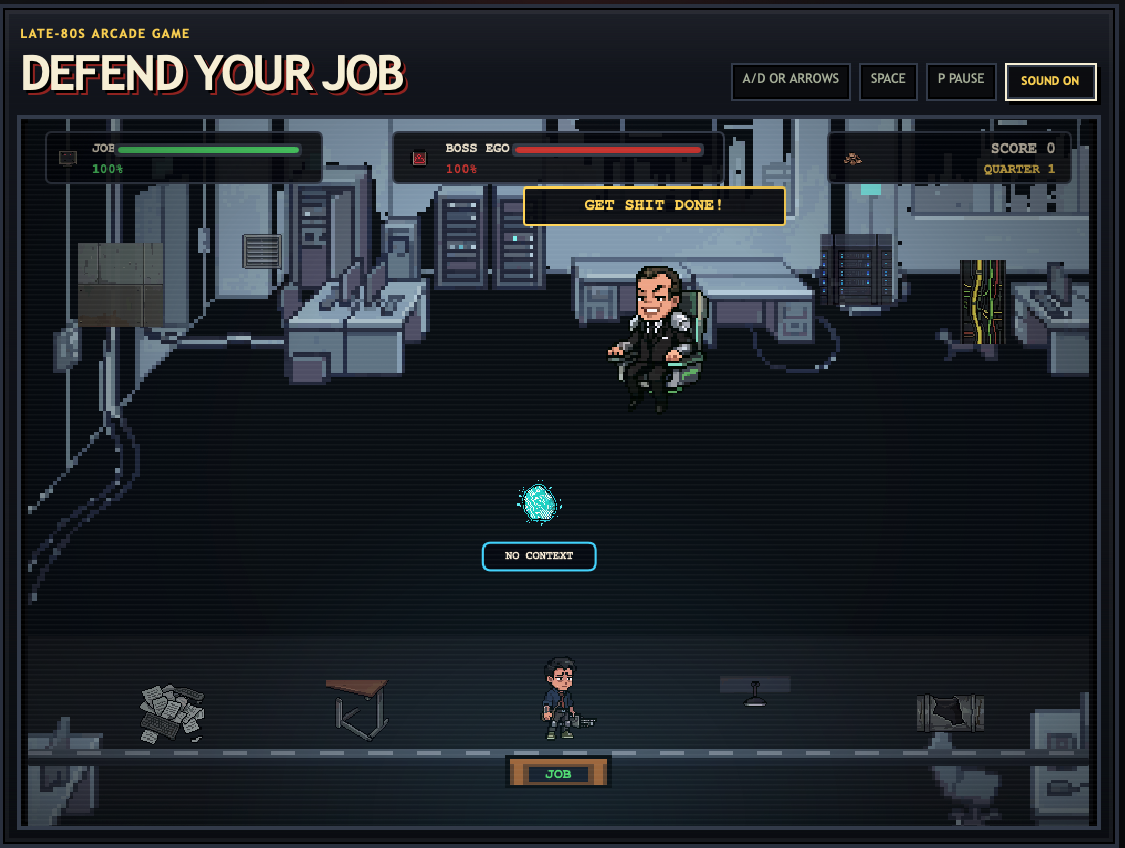
The healthy response to losing a job is probably long walks and a journal. I opened a code editor and started building a game where a little sprite dodges things labelled AI SLOP.
When you're let go through no fault of yours, it's not easy to process that. And like so many hundreds of thousands of other folks that lately have seen their positions replaced by dubious decisions that had a lot to do with AI, I had all this energy and nowhere to put it. Some of it was anger, and I didn't trust myself to write anything honest while I was still that close to it. So instead of writing an angry post, or rehearsing the argument I wish I'd made in the room (although to be honest I didn't have that chance since I was fired at 10pm and just noticed it by chance, because I was working very late, when I shouldn't have, and the next day I was blocked from accessing my computer), I made a game and let the game do the arguing.
Why a game and not a rant
A rant would have been about me. What happened, who decided what, whether any of it was fair. I'm still too close to answer that well, and I think no one wants to read another person's grievance dressed up as a hot take.
The game made me actually excited to go through the experience again. When you turn a feeling into a mechanic you have to work out what the feeling is actually made of. What's the threat? What holds it off? What does surviving even look like? You can't answer those and stay vague, and you can't answer them and stay furious, because a furious game isn't fun and an unfun game is just a diary with a score counter.
So the silliness was a container I had created that could hold my real feelings about this whole debacle without them sloshing everywhere, and spilling into rage.
What the game is actually about
Here's the setup. You're a worker. Stuff flies at you and you dodge it or shoot it down. The incoming threats have names: AI SLOP, HYPE BOT, NO CONTEXT, BAD CALL, IGNORANCE. The powerups you grab to survive are things like HUMAN REVIEW, SCOPE SHIELD, a RUBBER DUCK for talking a problem through, a UNION CARD, a PROCUREMENT delay that buys you a few seconds. It's all inspired by 80s and early 90s arcade games because that's a nostalgic era to me, a time where I didn't have to worry about silly things like finding the next job or paying rent.
Like many of the things I'm building lately, this started as an idea about something I thought many people would enjoy, and that I wanted to build as a way to pass the time. Why did it feel good? Well, the enemy in the game is never AI itself. I use it every day and built other tools with it, so I didn't want to make a game about the robots coming for us, because I don't feel like AI is the enemy. The enemy is slop: the hype that treats a language model's confident guess as finished work, the decision made at speed by someone who mistook speed for judgment, or who thought a robot would come cheaper than a person. (Going by the rehiring headlines, it doesn't.)
And the things that keep the worker alive are all unglamorously human: you review the work, you know where the scope stops, you talk it out loud until it makes sense. I'd made that argument before, in plain words, in a post about why AI doesn't replace technical writers. But a sentence is easy to nod at and forget. In a boss fight where you have to beat the enemy with HUMAN REVIEW, I think it's harder to wave away.
What does this all mean
I thought building the game would just get the anger out of my system. It did some of that. But what stuck with me was smaller and stranger: I'd made my case better by not aiming at it.
When I go straight at the argument I get defensive and a bit mad, and you can smell it on the page. I don't want to make people read things I wouldn't read myself, and honestly I'm tired of hot takes. Pointing all that energy at a dumb arcade game instead, I think I made the same point but cleaner, because it had to survive being fun.
And honestly? I think the game resonates with a lot of us. It's silly, but plenty of people have been through the same thing, and the anxiety under it isn't only mine. Everyone doing knowledge work right now is watching the same question hang in the air: what, exactly, is still ours to do? I still believe humans are essential to the work — partly because AI isn't good enough to replace us, but mostly because I'm not sure I want to help build the kind of society that tries.
I could keep going here, and you can probably see how fast I slide from a game into a rant. So I'll stop. I don't have a tidy answer. What I've got is a small game that says your judgment matters — the review, the context, the call a machine can't quite make yet. Defend it. It's worth defending.
And defending it turns out to be more fun than being bitter about it. Who knew.